Frequently Asked Questions
Common questions about shot group analysis, shooting patterns, and how Shotalyze works.
Shot Group Analysis
How do I analyze my shooting target?
Photograph your paper target, then measure the distance between the two farthest bullet holes - this is your group size (or "extreme spread"). Identify which direction the group is offset from center, and classify the shot pattern (low-left, high, scattered, etc.). Each pattern maps to specific biomechanical causes with drills to fix them.
You can do this manually with a ruler and a pattern chart, or upload the photo to Shotalyze which automates the entire process using computer vision - detecting holes, measuring the group, classifying the pattern, and recommending drills.
What is group size in shooting?
Group size (extreme spread) is the distance between the centers of the two farthest-apart bullet holes in a shot group. It measures your precision - how consistently you shoot. A tight group means your mechanics are repeatable, regardless of where it lands on the target.
Group size is measured in mm or inches at the target. To compare groups shot at different distances, convert to MOA.
What is MOA?
MOA (Minute of Angle) is an angular measurement. 1 MOA equals approximately 1 inch at 100 yards or 29mm at 100 meters.
MOA normalizes group size across distances. A 2-inch group at 50 yards is 4 MOA. A 4-inch group at 100 yards is also 4 MOA. The shooter's precision is the same in both cases. The formula: MOA = (group size / distance) x 3438 (when both are in the same unit).
What is CEP?
CEP (Circular Error Probable) is the radius of the smallest circle, centered on the group's mean point of impact, that contains 50% of your shots. Where group size is dominated by your worst shot, CEP represents your typical performance.
Example: 10 shots with a CEP of 15mm means 5 shots landed within 15mm of the group center. CEP is more stable than group size for tracking improvement over time because one flyer barely changes it. Used in competitive and military shooting.
Shot Patterns & Causes
Why am I shooting low left?
Low-left is the single most common miss pattern for right-handed pistol shooters (low-right for left-handed). It is caused by one or more of:
- Trigger finger mechanics - too much finger on the trigger pulls the muzzle sideways
- Anticipation/flinch - bracing for recoil pushes the muzzle down before the shot breaks
- Grip imbalance - the gun torques under recoil prep when the support hand is too passive
Most shooters have a combination of two. The wall drill targets trigger control, ball-and-dummy targets anticipation, and the penny drill targets grip stability. Read our full guide: How to Fix Low-Left Shots.
What does my shot pattern mean?
When shots consistently cluster in the same off-center position, the pattern has a cause:
- Low-left (right-handed) - trigger control or anticipation
- High - heeling (pushing palm forward) or lifting the head
- Scattered - inconsistent fundamentals (grip, sight alignment, trigger)
- Vertical stringing - breathing inconsistency or varying cheek weld
- Horizontal stringing - trigger mechanics or wind
A pattern that appears across multiple sessions is a real problem worth fixing. A one-time pattern might just be a bad day. Read more about shot patterns.
How do I improve my pistol accuracy?
The fastest path to improvement is deliberate practice based on data, not just shooting more rounds:
- Measure your shot groups (group size, pattern, offset)
- Identify your dominant miss pattern
- Learn the biomechanical cause behind that pattern
- Practice the specific drill that fixes it
- Track whether it worked over multiple sessions
One focused drill session beats three sessions of unfocused shooting. Learn how to track your progress.
Scope Zeroing
How do I zero my scope?
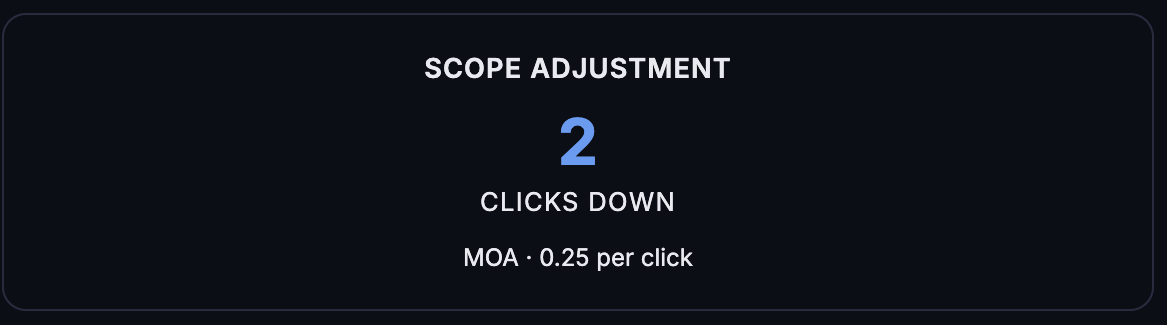
Shoot a group, then measure how far the group center is offset from the target center. Convert that offset to MOA or MRAD based on your shooting distance. Divide by your scope's click value to get the number of turret clicks needed.
Example: your group is 2 MOA left and 1 MOA high. Your scope has 1/4 MOA clicks. You need 8 clicks right and 4 clicks down.
Shotalyze (Pro) calculates this automatically when you set your scope type and click value on a gun - it reads the offset from your target photo and gives you the exact adjustment.
About Shotalyze
How does Shotalyze detect bullet holes?
Shotalyze uses a YOLO-based computer vision model fine-tuned on shooting target images. Upload a photo of your paper target and the app detects each bullet hole, measures group size, calculates CEP, and classifies your shot pattern.
If a hole is missed or a false detection appears, the manual correction editor lets you add, move, or remove holes and re-analyse.
What targets does Shotalyze support?
Shotalyze includes a built-in target library with correct ring dimensions for ISSF targets (10m air pistol, 25m rapid fire, 50m free pistol) and NRA targets (B-8, B-16, B-27). You can also create custom targets with your own specifications. Compare ISSF vs NRA targets.
Is Shotalyze free?
Yes. The free tier includes 3 analyses per day, group stats, pattern detection, and one coaching cause per analysis.
- Hobby ($9.99/mo) - 100 analyses/month, all coaching causes, trends, heat maps
- Pro ($19.99/mo) - 300 analyses/month, per-gun/ammo analytics, scope zeroing, cost tracking, CSV/PDF export
Create a free account to start.