Tracking Your Shooting Progress
April 19, 2026 · 7 min read
You go to the range, shoot a few magazines, feel like you did okay, and drive home. Two weeks later you do it again. After six months of this, you wonder whether you have actually gotten any better. The honest answer is you probably do not know, because you have no data.
Tracking your shooting progress is not complicated. It does not require expensive tools or obsessive record-keeping. But it does require some consistency, and the shooters who do it improve faster than those who rely on memory alone.
Why Memory Fails You
Human memory is terrible at storing quantitative results over time. We remember the good stuff and quietly bury the bad sessions. You might recall the day you shot a tight 2-inch group at 15 yards, but conveniently forget the three sessions before it where you were printing 5-inch patterns.
This selective memory creates a distorted picture of your actual skill level. Some shooters overestimate their improvement because they anchor on their best results. Others get discouraged because they fixate on a bad day and ignore the broader trend. Without written records, you are guessing.
There is also the comparison problem. You think you are shooting "about the same" as last month, but last month you were at 7 yards and today you are at 10. You switched from 115-grain to 124-grain ammo. It was 40 degrees colder. None of those variables exist in your memory unless you wrote them down.
What to Track
You do not need to record everything. A few key data points, logged consistently, give you enough to see real trends. Here is what matters most:
- Group size. Measure your best group and your average group for the session. Group size is the single most useful metric for tracking mechanical accuracy. Use a ruler, use calipers, or photograph the target and let software measure it.
- Shot patterns. Where are your misses going? Low-left, high, scattered? Patterns tell you which fundamentals are breaking down. Not sure what your pattern means? Our guide on how to read shot groups covers the common ones. A pattern that shows up across multiple sessions is a real problem. One that appears once might just be a bad day.
- Hit rate on a scored target. If you shoot bullseye, IDPA, USPSA, or any scored format, track your scores. Points per stage, hit factor, or percentage of A-zone hits all work. Pick one metric and stick with it.
- Distance. A 3-inch group at 7 yards is very different from a 3-inch group at 25 yards. Always note distance so your comparisons are valid.
- Ammo. Caliber, brand, grain weight. If you switch ammo and your groups change, you want to know whether it was you or the ammunition.
- Conditions. Indoor or outdoor, approximate temperature, wind if relevant. Keep this brief. "Outdoor, 55F, light wind" is enough.
- Round count. How many rounds you fired in the session. Useful for tracking fatigue effects and ammo budgets.
That is seven items. Most of them take less than 10 seconds to record. The key is that you actually do it every session, not that you write a detailed essay.
How to Log Sessions
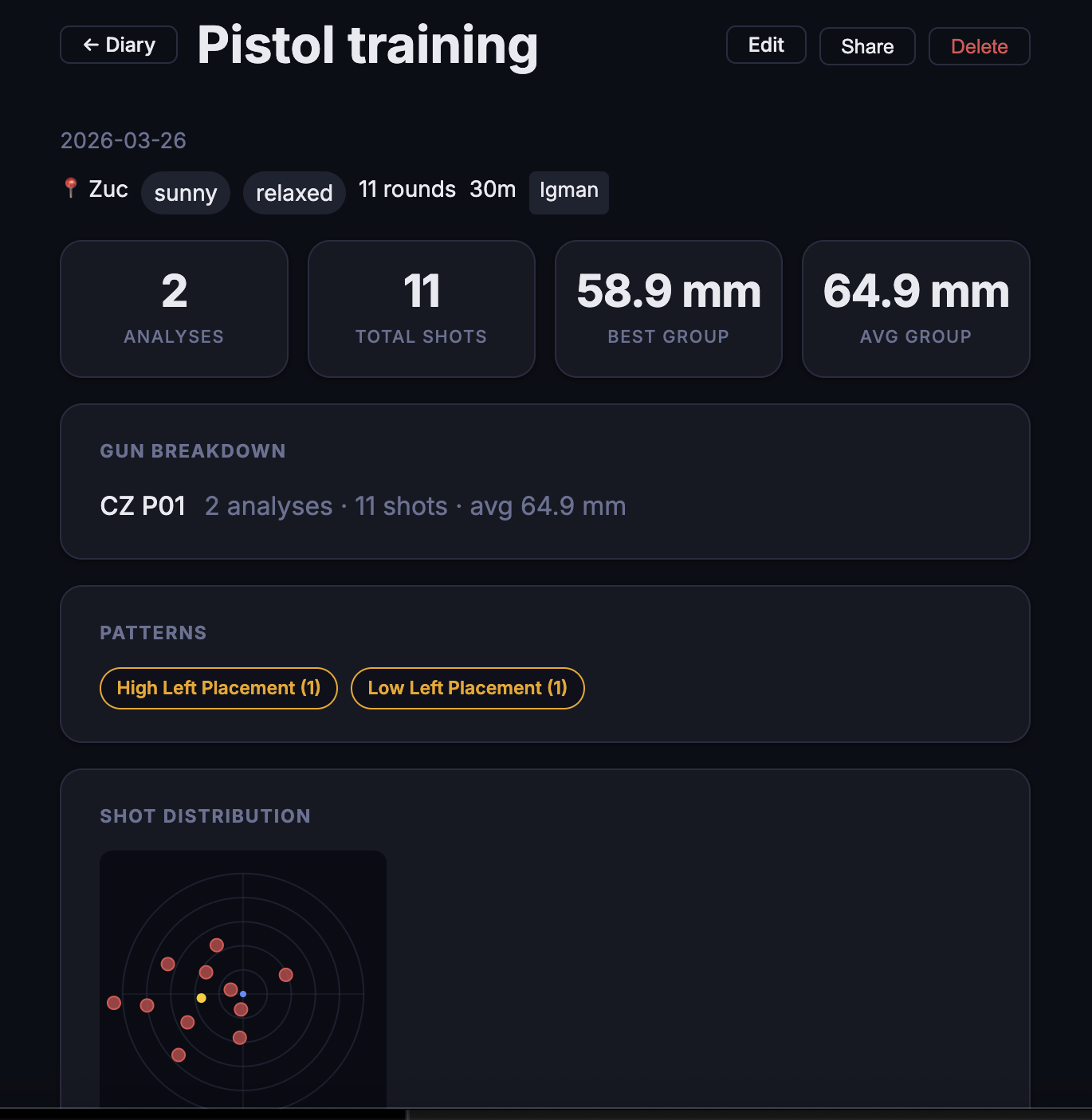 A diary entry with session stats, pattern tags, and shot distribution
The best logging system is the one you will actually use. That sounds like a cliche, but it is the most important principle here. A beautifully designed spreadsheet that you abandon after three sessions is worth less than a crumpled notebook page in your range bag that you fill out every time.
The quick-capture approach
At the end of each range session, before you pack up, take 60 seconds to do three things:
- Photograph your best target (or all of them, if you want more data)
- Write down the date, distance, ammo, and round count
- Add one sentence about how the session felt or what you worked on
That is it. A phone photo plus three short notes. You can do this in the time it takes to pack your magazines back into your bag. This minimal approach beats a detailed shooting diary that you stop maintaining after two weeks.
Where to keep it
Options, from simplest to most structured:
- Phone notes app. Create a running note called "Range Log." Add entries at the top with the date. Paste in photos. Zero friction.
- Paper notebook. Keep a small notebook in your range bag. Write the date, distance, ammo, group size. Old school but reliable, and it never runs out of battery.
- Spreadsheet. Columns for each data point. Good for people who want to graph trends later. Takes more discipline to maintain.
- Dedicated app. Tools like Shotalyze let you upload a target photo and automatically extract group size, shot count, and pattern data. The logging happens as a side effect of getting feedback on your target, which removes the extra step that causes most people to quit tracking.
Measuring Improvement Over Time
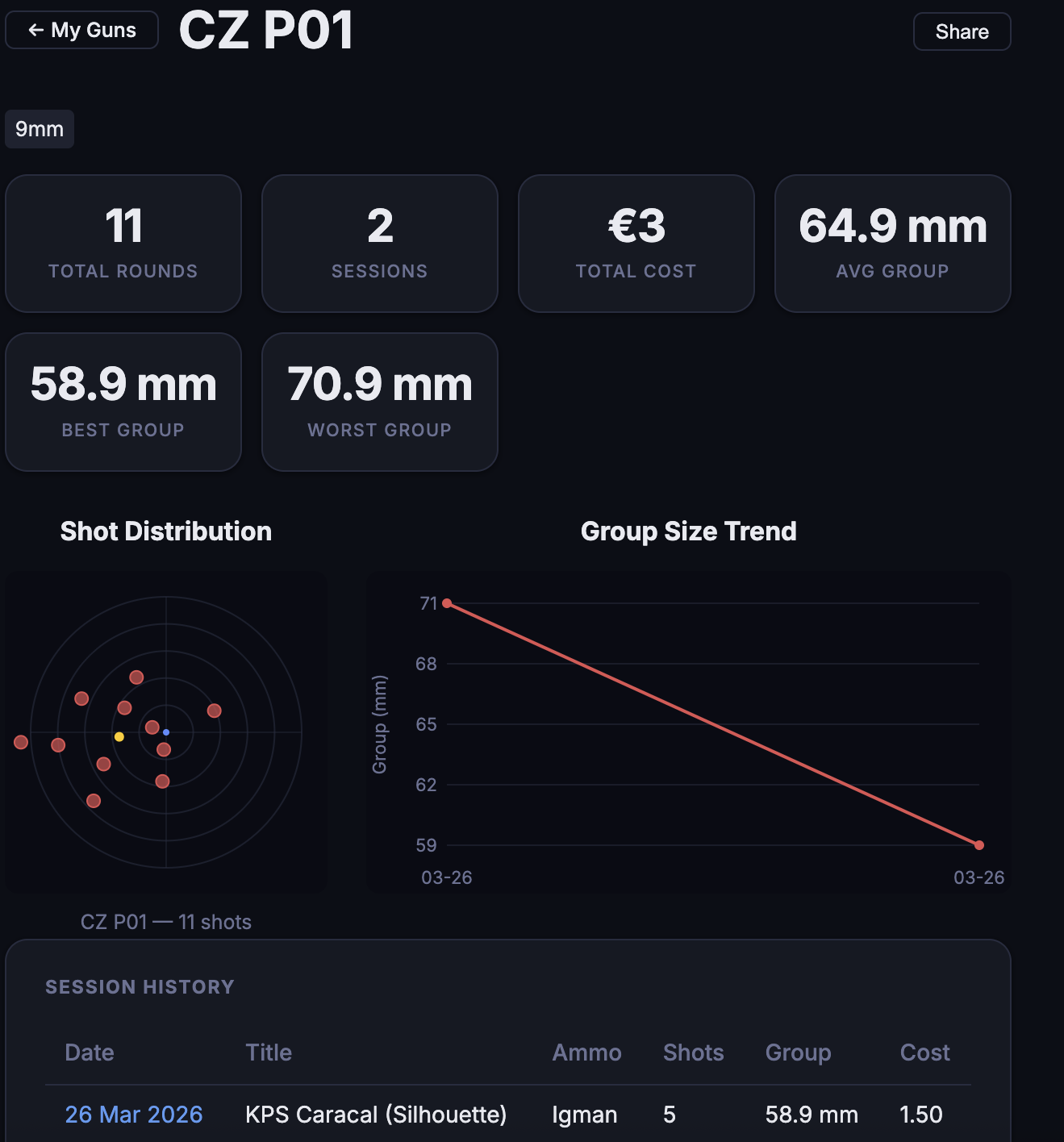 Per-gun trend chart showing group size improving over sessions
Raw numbers from a single session are noisy. You had a good day, or a bad day, or you were tired, or the range was crowded and you felt rushed. Individual data points bounce around. What you are looking for is the trend.
Set a baseline
Before you can measure improvement, you need a starting point. Spend one session shooting a standardized test. Pick a distance and round count you will repeat. For example: 10 rounds at 10 yards, slow fire, on a clean target. Measure the group. That is your baseline.
Come back to this exact test every four to six sessions. Same distance, same round count, same pace. Compare the results over time. This controlled test strips out most of the session-to-session noise.
Compare periods, not sessions
Instead of comparing Tuesday to last Tuesday, compare this month to last month. Average your group sizes across all sessions in each period. If your average group went from 4 MOA to 3.2 MOA over two months, that is real progress you can point to. A single session where you shot 2.5 MOA does not mean you are a 2.5 MOA shooter. Your average across 8 to 10 sessions is a much more honest number.
Watch for plateaus
Improvement is not linear. You will make fast progress early, then hit a plateau where nothing seems to change for weeks. This is normal. Plateaus usually mean you have optimized the easy stuff and need to address a deeper fundamental. Your tracking data helps here: if group size has been flat for six sessions, look at your pattern data. Maybe your groups are consistent but all shifted left. That tells you exactly where to focus next.
Setting Goals That Work
Vague goals produce vague results. "Get better at shooting" is not a goal. It is a wish. Effective goals are specific and measurable, tied directly to numbers you are already tracking.
Good goals
- "Sub-2 MOA average group at 25 yards by September"
- "90% A-zone hits in USPSA classifiers this season"
- "Reduce average group size by 20% at 15 yards over the next 3 months"
- "Eliminate low-left pattern at 10 yards within 5 sessions"
Bad goals
- "Get better"
- "Shoot tighter groups"
- "Be more consistent"
The difference is obvious: good goals have a number and a deadline. You can look at your log and say definitively whether you hit the target or not. Bad goals let you rationalize anything as progress.
Start with one goal at a time. Work on it for a month. When you hit it, set a new one. Stacking multiple goals just dilutes your focus.
Tools vs. Notebooks
Some shooters like paper logs. Others prefer apps. Neither is wrong, and the best choice depends on your personality and how much friction you can tolerate before you stop doing it.
Paper notebooks are simple and distraction-free. You write what you want, how you want. The downside is that you cannot easily calculate averages, spot trends, or compare across sessions without doing the math yourself. If you are disciplined enough to go back and review your notes regularly, paper works fine.
Apps and digital tools handle the analysis for you. Upload a photo, get measurements. Your history builds automatically. You can see trend lines, compare time periods, and spot patterns without manual effort. Shotalyze takes this approach, turning target photos into structured data so your shooting log populates itself every time you upload. The tradeoff is that you need your phone and an internet connection.
Spreadsheets sit in the middle. You get charts and calculations, but you have to enter the data manually. Good for people who enjoy data entry. Less good for people who do not.
The honest recommendation: use whatever has the least friction for you. If you hate apps, use a notebook. If you hate writing, use an app that captures data from photos. The only wrong answer is not tracking at all.
Start Now, Not Later
The most common mistake is waiting until you are "serious enough" to start tracking. Every session you shoot without logging is data you cannot get back. You do not need to be a competitive shooter to benefit from tracking. Recreational shooters who log their sessions improve faster simply because they pay more attention to what they are doing.
Your next range trip, take 60 seconds at the end to snap a photo and jot down three notes. Do that five times and you will have enough data to see your first real trend. That is when tracking stops feeling like homework and starts feeling like an advantage.
Start tracking today: Shotalyze logs every session automatically - group size, patterns, and trends over time. Upload a target photo and your data starts building.